Login
Login
From STEM-professions to DeepTech: Challenges and Opportunities for the Kyrgyz Republic
The article by Talaibek Koichumanov. High Technology Park of the Kyrgyz Republic.
Abstract. The aim of this study is to analyze the characteristics influencing the innovative development of the Kyrgyz Republic, identify its weaknesses, and to explore opportunities for improvement. The methodology used is an analysis of the Global Innovation Index indicators for 2022-2025. The article pays special attention to the implementation of STEM education. To analyze and assess the potential for technological development, the concepts of the Smile Curve and the country's economic complexity are considered. The DeepVine concept is presented as a catalyst for technological progress, representing an interconnected ecosystem between science, education and high-tech business. Unlike existing theories of catch-up development, which view digitalization as a tool for modernization, DeepVine interprets IT and artificial intelligence as an architecture for accelerated growth capable of compensating for structural limitations. The study's results can be used in developing a long-term IT development strategy in the Kyrgyz Republic.
Keywords. High technologies; innovation; Global Innovation Index; STEM occupations; DeepTech; technological leapfrogging concept
Introduction. The development of high technologies is a key condition for national economic growth. The purpose of this article is to analyze the factors influencing innovative development, identify its weaknesses, and explore opportunities for improvement. Particular attention is paid to STEM education, since in the era of artificial intelligence (AI), technical thinking is becoming a crucial aspect of scientific decisions. The methodology used in the article is an analysis of the Global Innovation Index (GII) indicators for the Kyrgyz Republic in recent years, as well as the Smile Curve and economic complexity concepts to measure the quality and potential of the national economy. The author introduces the concept of DeepVine, a catalyst for technological progress that represents an interconnected technological ecosystem that unites science, education, and high-tech business. In contrast to existing theories of catch-up development, which view digitalization as a tool for modernization, DeepVine interprets IT and AI as mechanisms for accelerated growth that can compensate for structural limitations.
Materials and Methods. Before we begin to analyze the impact of education on innovative growth, let's clarify what we mean by "high technology." First of all, these are technologies that are characterized by a high degree of innovation, complexity, and level of intellectualization. The implementation of innovations is an essential condition for achieving high-tech levels. The recognition of innovations that increase the technological level of the economy as a key factor in economic development has led to the emergence of a new development paradigm based on the use of knowledge and innovation as the most significant economic resource. According to estimates by British economist Angus Maddison, a 1% increase in education spending results in a 0.35% increase in gross domestic product [1]. American economist Richard Easterlin calculated that, following major educational reforms, economic growth typically begins after a time lag of approximately 25 - 30 years. He believes that the Industrial Revolution of the 19th century gained momentum only thanks to reforms in the education systems of countries around the world [2]. Numerous empirical studies conducted by scholars in various countries confirm the existence of a strong positive relationship between education and economic growth [3]. For example, in [4], for the period 1996-2004 and for 42 countries, the authors found a strong relationship between higher education, innovation, and economic growth. According to their calculations using the DOLS model and panel cointegration analysis, a 1% increase in R&D spending is associated with a 0.854% increase in GDP over the period under review, and a 1% increase in higher education spending affects a 2.862% increase in GDP over the period under review.
Let us briefly analyze the main GII indicators for the Kyrgyz Republic. By evaluating the factors that support innovation activities, the GII makes it possible to identify national strengths and weaknesses as well as relationships between key indicators. According to the 2025 results of the GII, the Kyrgyz Republic ranks 96th out of 139 economies assessed [5]. Overall, the Kyrgyz Republic continues to face substantial challenges and demonstrates relatively low performance across most innovation-related indicators. The only positive aspects are that the Kyrgyz Republic stands out for its education spending (5th in the world) and is among the top 15 countries for low-carbon energy use (14th), reflecting its strengths in environmental sustainability.
This paper does not provide a detailed examination of all 81 indicators used in the GII framework. A comprehensive analysis was presented in the author’s previous publication "From STEM-professions to High-Tech" [6]. Let us note only the main conclusions that have a direct impact on the innovation environment. In order to strengthen the innovation potential of the Kyrgyz Republic, it is necessary to increase expenditure on research and development, expand the number of researchers, and enhance the involvement of both universities and the private sector in research activities. The education system itself, both school and vocational and higher, requires radical reform – the disconnect between education and the economy is particularly evident in STEM professions. Infrastructure remains a major constraint on innovation-driven growth, especially in terms of information and communication technologies (ICT) and transport connectivity. In the ICT component of the GII, the Kyrgyz Republic ranks 82nd out of 139 countries. The "Business sophistication" component represents one of the most significant constraints on innovation development. It is characterized by a low share of highly skilled workers, limited collaboration between universities and industry, weak participation in international innovation networks, minimal private and public expenditure on R&D, and a low level of patenting activity. These indicators reflect an underdeveloped innovation ecosystem, limited technological integration and insufficient engagement in global innovation value chains.
The findings are important for our analysis; we have determined what is needed to improve the overall innovation situation in the country, which, in turn, is a necessary condition for the development of high technologies.
We now turn to the second part of the analysis and consider what type of education is required to meet the needs of high-technology sectors and under what conditions education can contribute to the emergence of innovative solutions. Over the past decades, global labour markets have experienced a steadily growing demand for engineers and technical specialists. The most prominent group of high-potential STEM professions worldwide are related to engineering disciplines. Indeed, engineering specializations are clearly present in the titles of most of the professions included in the top 15 STEM professions worldwide as of 2021 [6]. According to local experts, Kyrgyzstan is experiencing a severe shortage of highly qualified specialists with higher education [7]. One of the underlying causes of this situation is the low quality of school education. According to a study conducted by the non-governmental organisation KG Analytics, more than 50% of students in the country do not reach basic proficiency levels in mathematics and natural sciences. This directly affects academic success in higher education and limits the supply of well-prepared technical specialists for the economy [8].
Another major challenge concerns the quality of university curricula and teaching practices. Graduates often lack practical and applied skills, which negatively affects their performance in professional environments.
Table 1. Top 15 STEM occupations (2024)
No. | Occupation | STEM field | Relevance index* |
|---|---|---|---|
1 | Software Developer | Technology / Computer Science | 9.5 |
2 | Data Scientist | Technology / Analytics / AI | 9.3 |
3 | Information Security Analyst | Technology / Cybersecurity | 9.2 |
4 | IT Manager | Technology / IT Management | 9.0 |
5 | Biomedical Engineer | Engineering / Biotechnology | 8.8 |
6 | Chemical Engineer | Engineering / Materials / Manufacturing | 8.5 |
7 | Computer Hardware Engineer | Technology / Electronics / Hardware | 8.4 |
8 | Industrial Engineer | Engineering / Manufacturing / Logistics | 8.3 |
9 | Actuary | Mathematics / Statistics / Finance | 8.2 |
10 | Web Developer | Technology / Web / Software Engineering | 8.0 |
11 | Environmental Scientist | Science / Ecology / Sustainability | 7.9 |
12 | Mechanical Engineer | Engineering / Mechanics / Manufacturing | 7.8 |
13 | Genetic Counselor | Science / Biology / Healthcare | 7.7 |
14 | Biostatistician | Mathematics / Biology / Healthcare | 7.6 |
15 | Agricultural, Biological and Biosystems Engineer | Engineering / Agriculture / Biotechnology | 7.5 |
* The "Relevance index" is a subjective score (0-10) reflecting a combination of labour-market demand, employment growth and the global importance of the occupation.
Source: U.S. Bureau of Labor Statistics (BLS), Employment in STEM Occupations; National Science Foundation (NSF) / National Center for Science and Engineering Statistics (NCSES), US STEM Workforce: Size, Growth, and Employment; Oak Ridge Institute for Science and Education (ORISE), What STEM careers are in high demand? (based on BLS data, 2024).
The rapid development of AI in recent years has significantly transformed approaches to STEM education and workforce preparation. In practice, almost all STEM occupations today employ AI not only as an instrument for automation, data analysis and forecasting, but also as an integrating layer connecting disciplines, processes and technological systems [9, 10].
A key institutional model for such an ecosystem can be expressed through the following development pathway: school → university → research → start-up → market. The role of the state and quasi-public institutions, including the High Technology Park of the Kyrgyz Republic (HTP), is to act as system integrators and coordinators that connect the individual components of this ecosystem.
The reform of STEM education in schools and higher education institutions in the Kyrgyz Republic requires a systemic approach. Education system reform should include the development of modern curricula, the training and motivation of qualified teaching staff, the creation of adequate infrastructure and digital learning resources, the development of realistic career paths, and strengthening ties with industry. This is a topic for a separate article.
Overall, education reform must be guided by a clear understanding of the main structural trends in the global economy. Traditional roles of programmers and core coding specialists are becoming less important, and the demand for specialists in the design, integration, and management of AI-based systems, data analysis, cybersecurity, and cross-disciplinary problem solving is rapidly growing. Accordingly, universities responsible for training IT professionals should shift from a narrow focus on teaching programming skills towards the development of systems thinking, interdisciplinary competencies and practical experience in working with AI and data-driven projects. Leading technological universities worldwide already operate according to this paradigm. The transformation of education and human-capital development must therefore become one of the central priorities of public policy aimed at strengthening the country’s innovation capacity and long-term economic competitiveness.
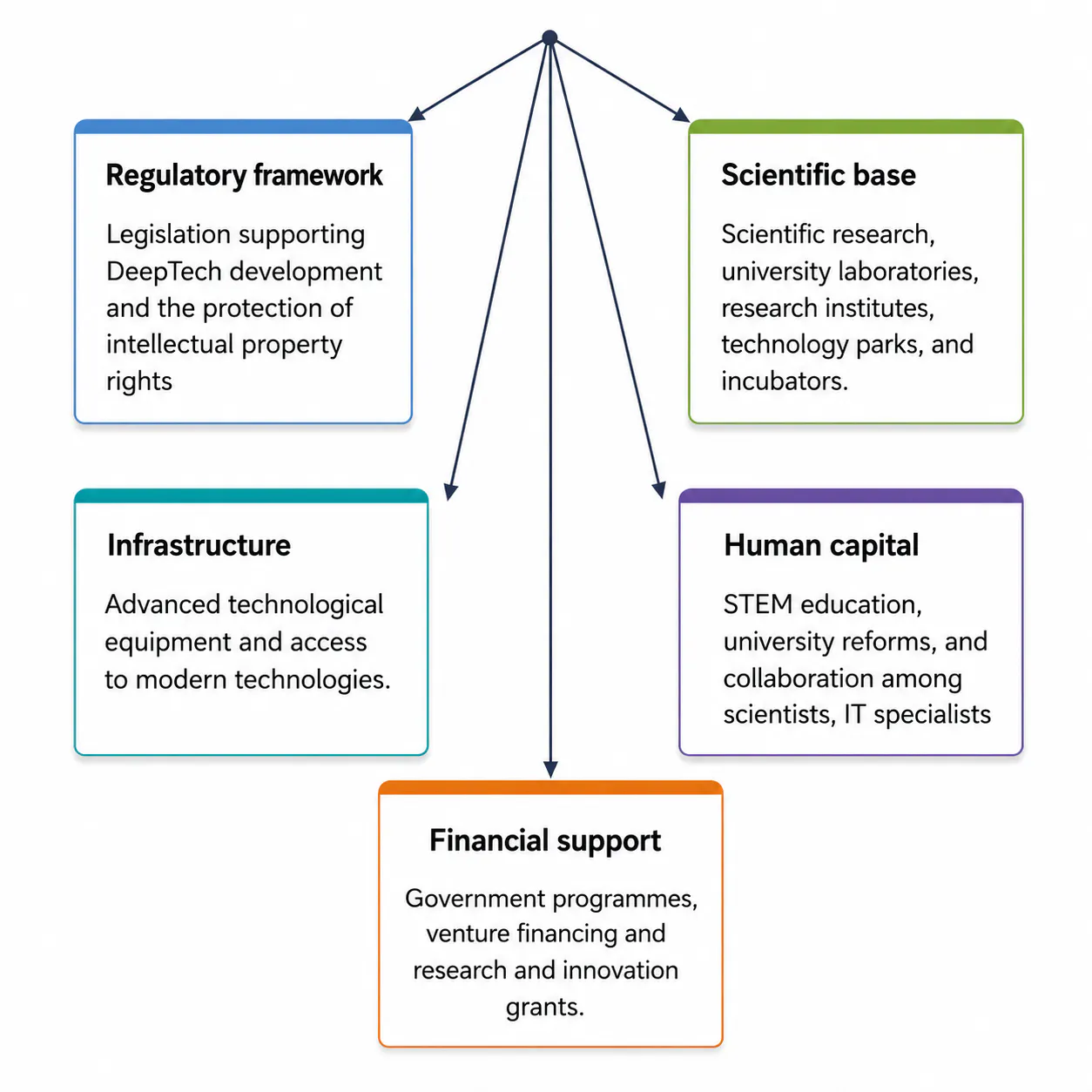
To better understand the above-mentioned issues within the global transition to DeepTech, it is necessary to identify the key challenges facing the emergence of DeepTech startups in the Kyrgyz Republic. In addition to reforms in school and higher education, the following elements are required: university laboratories, public research grants, venture capital funds, a supportive legal framework, and international partnerships (see the DeepTech start-up diagram)
Across all of these dimensions, a number of initiatives are already being implemented in the Kyrgyz Republic. In several of these areas, the HTP acts as a key catalyst. Without going into institutional details, it should be emphasized that the creation of a DeepTech ecosystem for the emergence of science-based start-ups requires a comprehensive approach, including improvements in the regulatory environment, institutional reforms and systematic human-capital development. The HTP actively contributes to the formation of such a future-oriented ecosystem, ranging from support for school olympiads and the organization of international scientific and practical conferences in high technologies to the direct support of start-ups and their entry into international markets. At the same time, the successful transition towards DeepTech requires substantial and coordinated efforts by the government, the IT community, academic institutions and international partners.
Scientific start-up ecosystem
The following section evaluates the potential macroeconomic impact of the above reforms for the national economy. The author proposes the DeepVine concept as an opportunity for the Kyrgyz Republic to achieve a technological leap. Most low- and middle-income countries (LMICs), including the Kyrgyz Republic, have access to modern digital technologies. However, they remain structurally limited in terms of institutional and economic capacity. Despite rapid development of the information technology sector and digitalization, these countries are largely dominated by low-value-added industries, such as textiles and agriculture, which are unable to break them out of the low-equilibrium trap. The Smile Curve theory (Shih, 1996) explains this phenomenon by demonstrating that the highest value creation is concentrated at the "ends" of the value chain - namely in research and development and branding - whereas countries specialising primarily in production capture the smallest share of value [11]. Digitalisation without science and innovation does not allow countries to move upward along this curve; it merely reduces the cost of existing production processes. The proposed conceptual framework is based on the premise that technological leapfrogging becomes possible only through the formation of "intellectual ecosystems", that is, dense and functional linkages between education, science and high-technology industries. To describe this mechanism, the paper introduces the DeepVine concept - a "technological vine" - within the jungle market metaphor ("Monkey Tree Metaphor", Sandy Wight, Mick Hager, Steve Tyink, 2007) [12]. This conceptualisation suggests that developing economies can "leap" over traditional stages of industrialisation and directly enter sectors characterised by high value added.
This technological leap is consistent with the Leapfrogging concept in economics, according to which countries and companies skip one or more stages of classical development and immediately implement advanced technologies and models [13]. In the proposed framework, such leapfrogging becomes feasible through the construction of the DeepVine ecosystem, which integrates education, scientific research, and the IT industry in order to accelerate economic growth.
Results. We propose a conceptual model of a technological "vine," DeepVine, linking education, science, and business to achieve accelerated economic growth through high technology. Unlike existing theories of catch-up development (Lee, 2019; UNCTAD, 2021) [14, 15], which view digitalization as a tool for modernization, DeepVine interprets IT, and AI in particular, as a shock absorber for accelerated growth, capable of compensating for structural constraints (weak institutions, uneven income distribution, dependence on raw materials and imported technologies, ineffective education systems and labor markets, etc.) in developing countries. The role of AI is defined as a key tool for DeepVine, capable of radically reducing transaction costs, automating processes, and creating intelligent systems.
The key contributions of the proposed approach can be summarised as follows.
- DeepVine is interpreted as a "feedback network": science → education → IT industry → innovation → export → investment → new science. This means that DeepVine is not simply a digital platform or AI model, but a connected technological ecosystem capable of strengthening the knowledge economy through the constant circulation of data, expertise, and investment.
- Quantitative hypothesis: with the integration of DeepVine linkages, the annual growth rate of the Economic Complexity Index (ECI) could increase by approximately 0.10 - 0.15 points, based on comparative trajectories observed in Viet Nam and Estonia.
- The systemic role of AI: AI reduces transaction costs between key nodes in the ecosystem by automating data analysis, improving educational programs, and supporting more efficient business decision-making, thereby strengthening the overall interconnectedness within the DeepVine ecosystem.
- Strategic application for the Kyrgyz Republic: the creation of DeepTech growth zones, integration of universities with private R&D centres, and the deployment of AI infrastructure to support entry into global knowledge and technology markets.
Overall, the proposed framework establishes the foundation for a new type of technological policy - referred to as the Connected Growth Model - in which AI is not merely a technology but a structural development mechanism.
The theoretical background of the concept is presented below.
The "Smile Curve" visualizes the distribution of added value along a product's value chain: as described above, digitalization without science and innovation does not move countries up the "Smile Curve," where production has high added value. Countries confined to low-income manufacturing and service activities lose a substantial share of potential economic gains. For developing economies located at the lower part of the curve, the key challenge is to move upward through innovation and branding.
The Economic Complexity Index (ECI) (Hidalgo and Hausmann, 2009) measures a country’s capability to produce a diverse and technologically sophisticated set of products [16]. A higher ECI is positively associated with long-term economic growth and innovative capacity, which makes it an important indicator of national readiness for technological leapfrogging. This implies that innovation is the primary mechanism enabling developing countries to move beyond the middle-income and low-value-added traps.
The DeepVine concept extends the economic leapfrogging framework by focusing on the connectivity of the core components of accelerated development. The main nodes of the technological ecosystem are science (knowledge and patents), education (the transformation of knowledge into human capital), IT and DeepTech sectors (the conversion of talent into innovations and products), and exports and investment (the reinvestment of economic returns into science and education). In this system, AI is a kind of "sap of the vine," running through all the nodes, whose essence manifests itself in the automation of R&D and data analysis, the personalization of education, the optimization of production and logistics, and the global scaling of innovation. In fact, AI here acts as an accelerator, enabling a "technological leap."
Figure 1. The DeepVine model
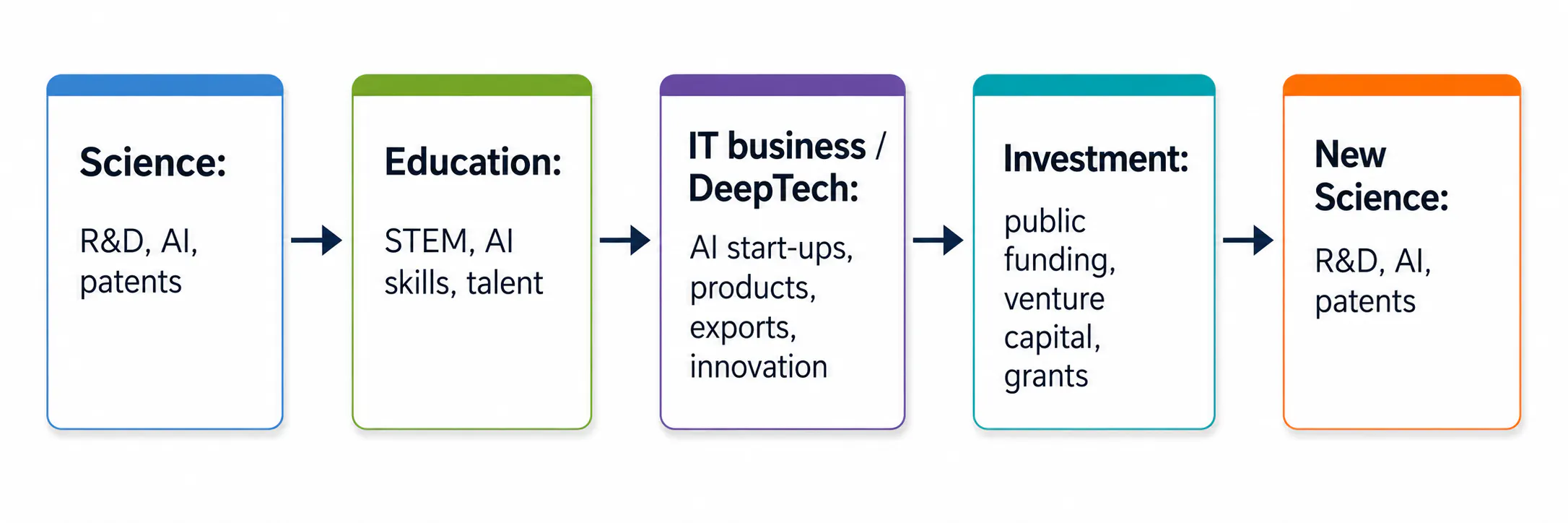
AI is seen here as a "connection catalyst" that runs through all nodes (can be thought of as a network of neural connections that reinforce the cycle).
Discussion. Examples of successful technological leapfrogging include the economies of Viet Nam, Estonia and Rwanda, where the integration of DeepTech, AI and education policy has contributed to a new model of technology-driven growth and structural transformation [17-19]. Using the Kyrgyz Republic as a case study, this section examines how a similar "technological vine" - a connected technological ecosystem - can serve as an instrument for transitioning from digitalisation towards a knowledge-based economy, with a particular emphasis on the role of AI as a systemic accelerator.
A key structural challenge for developing countries is that, over the past decade, more than sixty developing economies have increased the share of ICT services in GDP, yet only twelve have experienced an improvement in their Economic Complexity Index (ECI) as calculated by the Harvard Growth Lab [20]. This demonstrates a key policy failure: digitalisation without innovation linkages does not generate sustainable value creation. Many developing countries have entered a "digital trap": they export programmers rather than products, produce code rather than patents. Without the creation of an integrated DeepVine technological ecosystem, developing countries risk becoming offshore production units of the digital economy rather than its intellectual centres. The DeepVine concept is designed to address this structural weakness by strengthening innovation linkages and accelerating interaction between science, education and business, thereby reinforcing the connection between knowledge generation and commercialisation.
The potential implementation of the DeepVine concept in the Kyrgyz Republic reveals both significant challenges and promising opportunities. Although the country has demonstrated relatively high economic growth in recent years, averaging more than 9 per cent annually, the structure of the economy remains dominated by low value-added sectors. The principal barriers to technological leapfrogging in the Kyrgyz Republic include extremely low R&D expenditure (0.06 per cent of GDP in 2023), limited participation of the private sector in innovation activities [21] and a low level of economic complexity. By comparison, R&D expenditure amounts to approximately 1.8 per cent of GDP in Estonia and 0.53 per cent in Viet Nam. The ECI of the Kyrgyz Republic stands at -0.85 (Harvard Growth Lab, 2023) [22], which places the country among economies characterised by a strong dependence on natural resources and low-technology services. At the same time, several favourable conditions for technological leapfrogging can be identified, including a young population with high potential for digital skills development, the expansion of IT education infrastructure, a growing start-up ecosystem, and the initiatives of the HTP aimed at building a national technological ecosystem (such as AI Academy, the Kyrgyz AI Research Institute, incubators, laboratories and AI-driven projects). The KaniTTS project, developed on the basis of an LLM, provides an illustrative example of how the DeepVine approach can enable Kyrgyz companies to enter global markets with high-technology products [23]. This article provides only the main directions for the formation of the DeepTech ecosystem; many questions were not included due to space limitations of the publication.
With regard to the practical implementation of the DeepVine model, the following roadmap is proposed. First, it is necessary to establish platforms for collaboration between science, business, and education, including university laboratories, incubators and accelerators, joint R&D projects, and targeted grant programmes for AI-oriented start-ups. Second, STEM education should be systematically introduced and strengthened across educational institutions through curriculum renewal with a focus on digital skills, entrepreneurship and research-based learning. Third, institutional support measures are required, including tax incentives for R&D, the development of technology parks in line with international best practices, and the promotion of international cooperation. Fourth, a national DeepTech ecosystem should be formed with a strategic focus on AI, big data and fintech, including the integration of digital start-ups into traditional industries. Finally, advanced AI-related specialisations should be further developed within the DeepTech ecosystem, including machine learning, data analytics, robotics and neural network technologies. Under the integration of the DeepVine model and an increase in R&D expenditure to 0.3 - 1.0 per cent of GDP, the ECI of the Kyrgyz Republic could reach -0.5 by 2030. This would create the foundations for the emergence of a domestic DeepTech sector with an estimated export potential exceeding USD 300 million.
Conclusion. The creation of a holistic DeepTech ecosystem integrating STEM education, science, and industry paves the way for Kyrgyzstan to develop a sustainable middle class and strengthen the national economy overall. The government must actively promote reforms in education and science, create incentives for R&D, increase spending on such research, and attract additional funding to form the potential for technological leapfrogging. The DeepVine model offers a conceptual path for building technological ecosystems in which knowledge, human capital, and business mutually reinforce each other, with AI acting as a "connection catalyst". DeepVine should be understood not simply as a metaphor, but as a concrete policy tool for interconnected growth, in which each node of the ecosystem contributes to technological progress. A special focus on STEM education emphasizes that the talent of the young generation represents the country's most valuable strategic resource.
References
1. Maddison, A. (1991). Dynamic forces in capitalist development: A long-run comparative view. Oxford University Press. https://onlinelibrary.wiley.com/doi/10.1111/aehr.341br3
2. Easterlin, R. A. (1981). Why isn’t the whole world developed? The Journal of Economic History, 41 (1), 1-19. https://faculty.econ.ucdavis.edu/faculty/gclark/210a/readings/Easterlin.pdf
3. Bozhechkova, A. V., Klyachko, T. L., et al. (2019). Obrazovanie i ekonomicheskii rost [Education and economic growth] (Scientific report). RANEPA. https://www.iep.ru/files/text/scientific_report/education.pdf
4. Bouhajeb, M., Mefteh, H., & Ben Ammar, R. (2018). Higher education and economic growth: The importance of innovation. Atlantic Review of Economics, 1 (01). https://www.aroec.org/ojs/index.php/ARoEc/article/view/58
5. World Intellectual Property Organization (2025). Global Innovation Index 2025: Results. https://www.wipo.int/web-publications/global-innovation-index-2025/en/gii-2025-results.html
6. Koichumanov, T. (2024). From STEM professions to High-Tech. Third International Scientific and Practical Conference "Innovation Development in Global Science". Boston, USA. InterConf, (186), 154-163. https://archive.interconf.center/index.php/conference-proceeding/issue/view/26-28.01.2024
7. Kakie tri glavnye problemy ispytyvaet rynok truda v Kyrgyzstane [What are the three main problems facing the labor market in Kyrgyzstan]. (2022, November 11). Economist.kg. https://economist.kg/novosti/2022/11/11/kakie-tri-glavnye-problemy-ispytyvaet-rynok-truda-v-kyrgyzstane/
8. National Statistical Committee of the Kyrgyz Republic. (2019), May 8. Analiz sovremennogo sostoyaniya rynka truda i proizvoditelnosti truda [Analysis of the current state of the labor market and labor productivity]. https://stat.gov.kg/ru/news/analiz-sovremennogo-sostoyaniya-rynka-truda-i-proizvoditelnosti-truda/
9. Shanbhogue, R. (2024). Will the bubble burst for AI in 2025, or will it start to deliver? The Economist. https://www.economist.com/the-world-ahead/2024/11/18/will-the-bubble-burst-for-ai-in-2025-or-will-it-start-to-deliver
10. World Economic Forum (2025). The Future of Jobs Report 2025. World Economic Forum. https://www.weforum.org/publications/the-future-of-jobs-report-2025
11. Smiling curve. (n.d.). In Wikipedia. Retrieved May 20, 2025, from https://en.wikipedia.org/wiki/Smiling_curve
12. Wight, S., Hager, M., & Tyink, S. (2007). Monkey Business: 7 laws of the jungle for becoming the best of the bunch. Gibbs Smith
13. Brezis E.S., Krugman P.R., Tsiddon D. (1993) Leapfrogging in international Competition: A theory of Cycles in National Technological Leadership. American Economic Review, 83 (2), 1211–1219. www.jstor.org/stable/2117557
14. Lee, K. (2019). The Art of Economic Catch-Up: Barriers, Detours, and Leapfrogging In Innovation Systems. Cambridge University Press.
15. United Nations Conference on Trade and Development (2021). Technology and Innovation Report. https://unctad.org/page/technology-and-innovation-report-2021
16. Hidalgo, C. A., & Hausmann, R. (2009). The Building Blocks of Economic Complexity. PNAS, 106(26), 10570–10575.
17. Vietnam: Science, Technology and Innovation Report (2020). World Bank Group. https://documents1.worldbank.org/curated/en/929681629871018154/pdf/Vietnam-Science-Technology-and-Innovation-Report.pdf
18. WIPO (World Intellectual Property Organization). Global Innovation Index 2025: Innovation at a Crossroads. https://www.wipo.int/web-publications/global-innovation-index-2025/en/index.html
19. Estonia 2024 Digital Decade Country Report. (2024). European Commission.
https://digital-strategy.ec.europa.eu/en/factpages/estonia-2024-digital-decade-country-report
20. Hausmann, R., Hidalgo, C. A., Bustos, S., Coscia, M., Simoes, A., & Yildirim, M. A. (2014). The Atlas of Economic Complexity: Mapping Paths to Prosperity. MIT Press. https://mitpress.mit.edu/9780262525428/the-atlas-of-economic-complexity/
21. Toward a New Policy for Scientific and Technical Communication: the Case of Kyrgyz Republic - Nurlan Djenchuraev, Cornell University, arXiv, 2004. https://doi.org/10.48550/arXiv.cs/0405001
22. Growth Lab at Harvard Kennedy School. (2024, September 24). Atlas of Economic Complexity 10.0 brings new data and Product Space design. Harvard Gazette. https://news.harvard.edu/gazette/story/newsplus/atlas-of-economic-complexity-10-0-brings-new-data-and-product-space-design/
23. nineninesix-ai. (2024). KaniTTS Project Repository [GitHub repository]. GitHub. https://github.com/nineninesix-ai/KaniTTS